
Unilever partnered with NovaceneAI to change how commodity market reports are analyzed — accelerating feature discovery, reducing manual effort, and turning unstructured intelligence into forecast-ready signals.
Customer: Unilever | Category: Procurement, Commodity Price Forecasting
Challenge
Unilever’s procurement teams needed to reduce slow, manual commodity analysis that limited market coverage, delayed buying decisions, and increased the risk of missing savings opportunities or being exposed to adverse price movements.
“As we proved that text-derived market signals could improve forecasting accuracy, it became clear that the real opportunity was not discovering those signals once—it was creating a repeatable way to discover them again and again. We wanted to turn an analyst-driven process into a reusable capability that could accelerate model development across projects.”

Mehrshad Kafi, PhD, Manager, Research Partnerships & Academic Programs, Horizon3 AI Labs, Unilever
Solution
NovaceneAI and the Unilever’s AI Horizon3 Lab developed the Automated Feature Extraction (AFX) module, an AI-powered commodity intelligence workflow that turns unstructured market reports into forecast-ready signals.
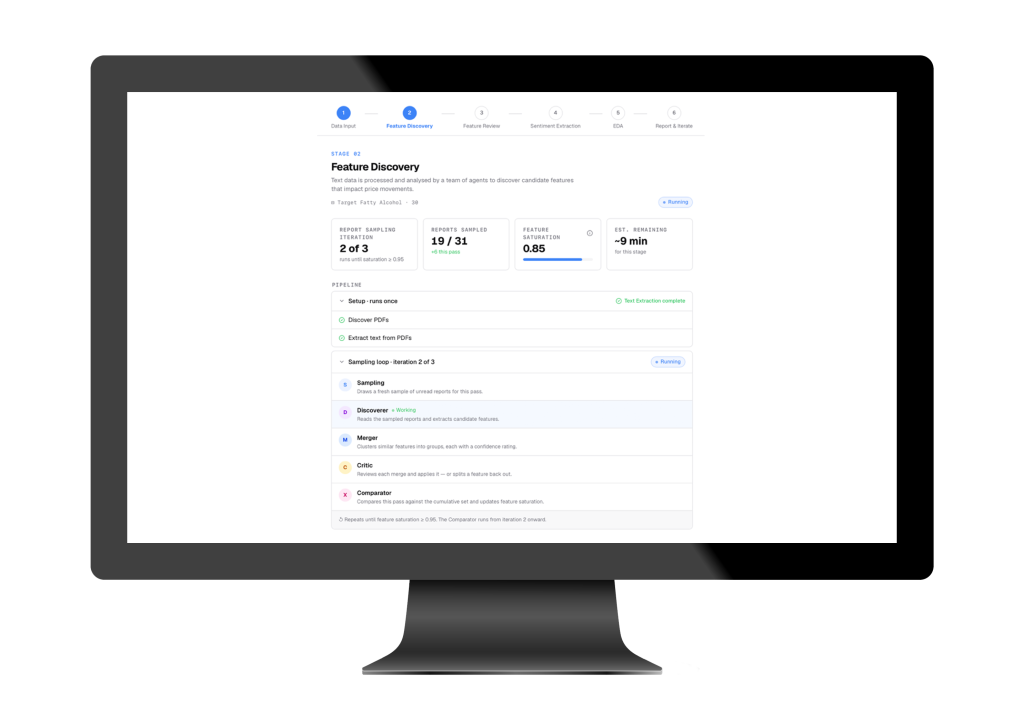
Using market reports and industry publications, AFX discovers forecasting-relevant themes, extracts sentiment signals, and produces structured variables that can be combined with historical prices to enhance traditional forecasting models.
The solution ingests PDF reports, identifies price drivers, extracts sentiment scores, validates feature quality, and produces structured outputs for multivariate forecasting. This gave data science teams a faster, more scalable way to convert market intelligence into usable forecasting inputs.
From Market Intelligence to Forecasting Signals
See how NovaceneAI and Unilever transformed years of unstructured market intelligence into validated forecasting signals, reducing time to insight from weeks to hours.

Approach
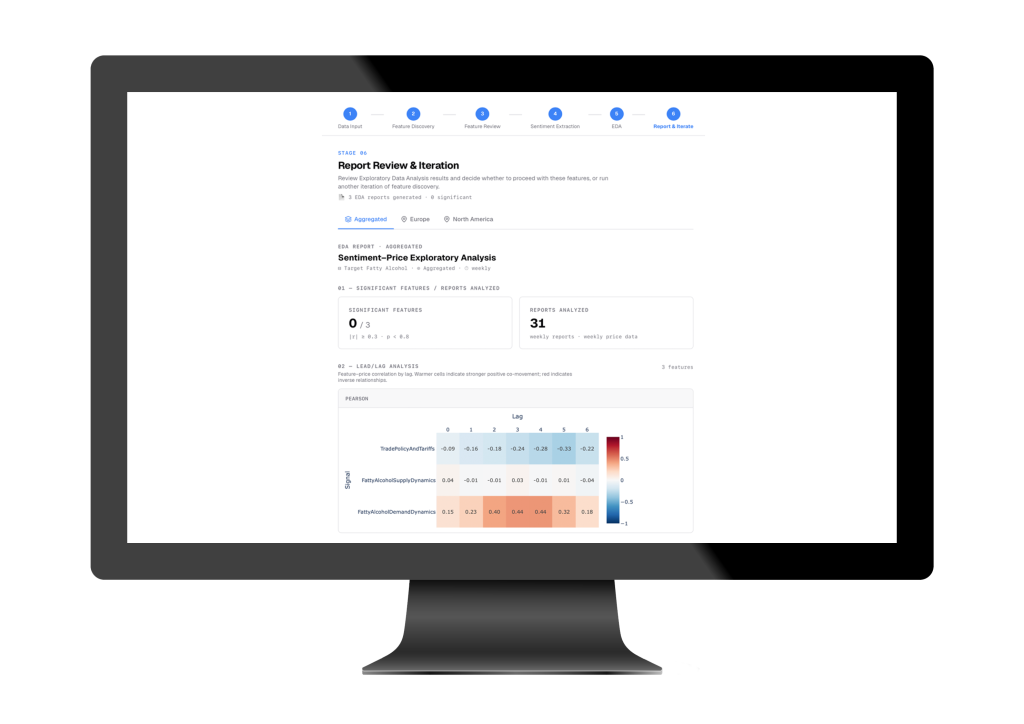
An agentic AI workflow automates the steps required to move from market intelligence reports to usable analytical information. It converts reports into machine-readable text, uses generative AI agents to discover and test candidate features, extracts sentiment scores, aligns those signals with price data, and runs linear and non-linear exploratory analysis. This method replaces a slow, manual process with a repeatable pipeline that improves coverage, consistency, transparency, and readiness for model training.
Results
The automated workflow materially reduced the time required to prepare market intelligence for forecasting. In one test set, feature-readiness work dropped from approximately 32 hours to 23 minutes, representing an 84x speedup. Another analysis that would have taken 110 hours was completed in under 3 hours, while the EDA stage alone fell from 2-5 hours per iteration to about 1 minute, reducing EDA time by more than 99%. Teams can now iterate faster, analyze broader document sets, and validate features more consistently before using them in forecasting models.
“This project shows why architecture matters in enterprise AI. By combining agent orchestration, checkpointing, parallel processing, and human review, the system turns a complex analytical workflow into a scalable and auditable capability.”

Beck Langstone, AI Solutions Architect, NovaceneAI
Reusability
Commodity price forecasting is one of many applications that leverage the Agentic Feature Extraction (AFX) module. The same discovery, validation, and extraction pipeline that turns market reports into forecasting signals works just as well on other document types: bank reports, incident logs, and industry publications for risk monitoring; supplier updates, shipping reports, and procurement documents for a variety of use cases.
Wherever an organization has large volumes of narrative text and a downstream model that needs structured input, the AFX module can be pointed at that archive to discover the relevant features, validate them, and extract them at scale.
In summary, the AFX module reads piles of messy text that humans don’t have time to read and turns them into structured numbers and scores that an AI model can plug into its predictions.
“When H3L shared their vision, NovaceneAI was already investing in a human-governed agentic framework designed to scale complex knowledge work. We saw a chance to use the learnings from this collaboration to create a reusable component for AI-ready data preparation and to test it on a forecasting use case with a proven methodology.”

Marcelo Bursztein, CEO, NovaceneAI