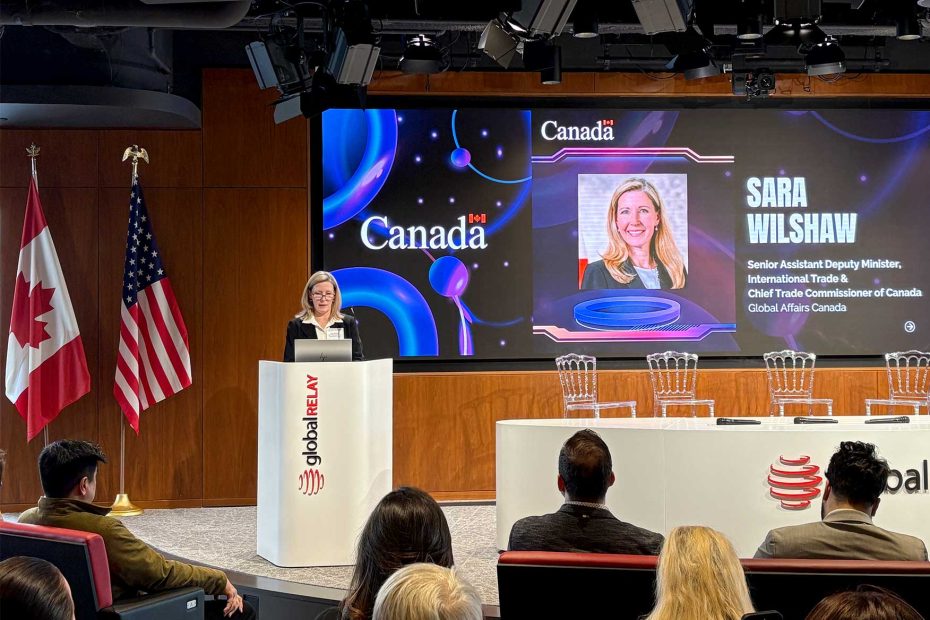
NEW YORK CITY, December 17, 2025 — Senior government officials, leaders from finance, venture capital, and industry gathered at Global Relay’s New York headquarters for the Canada–U.S. AI Business Opportunities Symposium, organized by the Consulate General of Canada in New York.
In a room filled with founders, investors, and enterprise AI leaders, the event echoed the conversations across most enterprise AI gatherings: the focus on AI has decisively moved beyond experimentation. Today’s key areas are deployment, governance, and measurable business value.
Opening Perspectives: AI in Cross-Border Trade
The symposium opened with remarks from Chris Hasenbein, EVP, Americas Sales at Global Relay; Sara Wilshaw, Canada’s Chief Trade Commissioner; and Dilip Chauhan, Deputy Commissioner from the NYC Mayor’s Office for International Affairs.
Wilshaw described AI as an economic growth engine that increasingly requires alignment across borders, regulators, and markets. Rather than positioning AI as a technological race, the opening remarks framed Canada–U.S. collaboration as a way to accelerate commercialization while preserving credibility, accountability, and market access.
Venture Capital Trends in AI Panel
Moderated by Nishta Rao from Citizens Private Bank, the venture capital panel brought together investors and enterprise leaders who see both sides of the funding equation. Panelists included managing partners from Two Small Fish, Matr Ventures, and Resilience VC, joined by JPMorgan Chase’s Global Head of Risk, Regulatory & AI Incubation.
The panel discussed how capital is flowing toward AI companies that can solve “boring,” niche back-office problems—such as building governed knowledge databases that power customer-service chatbot RAG workflows—meet regulatory compliance, integrate with legacy systems, and have the ability to scale.
Several speakers noted that many incumbent enterprise platforms, while deeply embedded—including systems like Salesforce or SAP—were not designed as AI-native environments, increasing the integration burden for teams attempting to operationalize AI at scale.
This has contributed to a broader market gap in truly AI-native enterprise solutions that combine workflow orchestration, evaluation, and governance by design, rather than as bolt-on features.
Industry Applications & Responsible AI Adoption
The second panel shifted from investment to operationalization, featuring both industry leaders and members from New York City Economic Development Corporation (NYCEDC) and New York-headquartered corporations. Moderated by Samrah Kazmi, CISO & Chief Innovation Officer, RESRG, an AI Advisory for Governments & Enterprises, the panel discussed the constraints often challenging AI adoption such as legacy systems, data governance, privacy, and the need for human oversight in AI-assisted decisions, particularly when teams are under pressure to demonstrate measurable productivity gains.
The strongest examples of success described AI not as a standalone product, but as an embedded capability—woven directly into business workflows where subject-matter experts remain in control and where agentic systems continuously evaluate and cross-check their own outputs, driving material performance uplift over single-pass automation.
Responsible AI as Competitive Advantage
The afternoon concluded with a fireside conversation between Bob McCubbing, Consul & Senior Trade Commissioner of Canada in New York, and Sebastian Gehrmann, Head of Responsible AI in the CTO Office at Bloomberg.
With Bloomberg’s role as a foundational data provider to the financial services industry—supported by hundreds of data engineers and scientists—the discussion underscored that responsible AI is inseparable from data quality, lineage, and institutional rigor.
Framed explicitly as “Responsible AI for a Competitive North America,” the discussion pushed back on the idea that governance slows innovation. Instead, transparency, auditability, and accountability were positioned as enablers of scale, providing safeguards and guardrails that allow innovation teams to move faster by default, rather than rebuilding controls each time—especially as AI systems increasingly inform consequential and irreversible decisions, such as assessing fairness, bias, and consistency in insurance underwriting and claims workflows using agentic AI.
In this framing, ongoing evaluation of how AI systems perform against defined tasks is itself a core governance function, not a post-deployment afterthought.
The Signal from New York
Taken together, the symposium made clear that the next phase of AI growth will be defined less by the next shiny new thing and more by trust.
For founders, investors, and enterprises alike, the opportunity is to operationalize AI in ways that institutions and organizations trust, employees can supervise, and markets can reap the rewards.
The Canada–U.S. AI Business Opportunities Symposium demonstrated why cross-border dialogue matters and why the future AI innovation agenda will be shaped as much by governance as by algorithms.